Wednesday, February 16, 2011

We begin our last week of work in Moshi

Dear Family and Friends,

Before describing the day’s activities, there are two major events to report: FIRST It has rained during each of the last two nights. What a difference a little moisture makes. The day’s heat has been reduced by 20 degrees, the dust has been dampened and the air is clean and fresh, the landscapes have greened up slightly, and everyone (including us!) seems energized. It feels like a different country. Tanzanian friends tell us that these are merely “Teaser Rains” and that the true rainy season is still a month away. Be that as it may, it is great to see what the country looks and feels like when it receives moisture and isn’t so bone-dry.

SECOND It was announced today that Kirk has set an all-time world’s record by eating watermelon at 47 consecutive meals (including breakfasts)! The old record was 44 set by a Maasai warrior in 1653. The watermelons here are juicy and sweet, deep red, and not too mushy. Kirk cannot resist. It is believed that when he leaves Moshi on Saturday his record of 63 consecutive meals with watermelon will never be equaled! The Association of Tanzanian Watermelon Growers is expected to acknowledge this achievement by awarding Kirk its annual honor for A Distinctive Lifetime Accomplishment of Major Significant to Tanzania’s National Viability.

Jean received a much more serious and meaningful honor today when the Executive Director of the House of Learning where she works asked if she would be able to extend her teaching service by two weeks!
Jean is doing a remarkable job of helping students prepare for their national qualifying exams, and the school she’s at recognizes and greatly appreciates her teaching skills. It was difficult for Jean to tell everyone that as much as she would like to stay, she is obliged to leave Moshi as scheduled.

Since this is the last week that we are in Moshi, we are working hard at completing the list of things that we want to accomplish while here. This afternoon Jean took care of two “to do’s.” #1… she bought some cloth in an African print, and then took it to a seamstress who will make a long caftan. Several female CCS staff members wear similar dresses, which they call “Butterfly dresses,” and they look elegant. Jean decided that she wanted one made for herself to bring home. #2… Jean also wanted to visit the huge Lutheran church here in Moshi and take a few pictures. It is a lovely church and would fit into any city in the US, except that there was a huge and highly visible Coca Cola sign inside the sanctuary, behind the last pew. Seemed really strange, but might be a new fund raising idea for American churches!

The young volunteer from Connecticut who took Jean shopping this afternoon led the two of them to a café which served yogurt shakes. Jean ordered a mango yogurt shake which was totally refreshing! What a great way to celebrate a good afternoon of shopping!

Kirk’s day was less eventful.
The teaching of ABC’s and simple addition went well, and so the children were rewarded with stickers in the shapes of pink and red hearts. As usual, the stickers were plastered on their foreheads, where they will stay for a couple days.

Near the end of the morning, while the children were playing, the teacher at the TunaHAKI orphanage asked Kirk for a private conversation. Kirk had suspected that this would happen before his departure on Friday. The teacher (a 26 year old named Deo) would like to get married and finish his college education but has no money to do either. He described how difficult and hopeless his life is without the prospect of a decent paying job that he needs before he can be independent and support a family. Deo says he is very depressed because he has no idea where he will ever find the money he needs to be a happy adult. He then asked if Kirk would sponsor him for two years at Tsh 800,000 ($550) @ year. Deo is a very decent and likable fellow with lots of potential. And Kirk truly feels sorry for him.

There are literally tens of thousands of young men in Moshi living under the same hopeless and depressing circumstances. These are some of the same conditions that give rise to the kind of protests and revolts that are taking place in northern Africa. At some point, the generation of young people in their 20’s and 30’s decides that there is no longer anything to lose in confronting their governments.

Kirk had expected for the past week that he would be approached by Deo.
His situation is heart-wrenching because there truly seems no way out of his dead-end life. This is the same fellow whose family cannot raise or borrow enough money to pay for their father’s surgery. Kirk would have been seriously inclined to become Deo’s sponsor and for $1100 invest in his future as a teacher and devoted family man. The chances are good that things would have worked out. Nonetheless, Kirk had to tell Deo that Cross Cultural Solutions has a policy that strictly forbids volunteers from contributing money to the organization they work with and its employees. The thinking is that the passing of money would quickly distort the relationship of CCS volunteers and their work to Moshi’s nonprofit community. We are here to offer our time and skills, not to be quick financial fixes. It was a difficult and disheartening conversation that left everyone feeling sad.

It’s time for bananagrams, M&M’s, and a good night’s sleep. Tomorrow we try again to climb up Mt. Kilimanjaro. We’ll see how far we get.

Love you all,
Mama Jean and Babu

Our Valentine Weekend Get-Away

Jean and I have been looking forward to our weekend get-away in Arusha. In part because we are eager to experience comfortable living conditions that include HOT water and a shower that produces more than a drip. But also because Arusha is much larger than Moshi and is considered the capital and political center of East Africa. It is more developed and offers many pleasures (such as ice cream, reliable internet services, and the International Herald Tribune newspaper) that I’ve missed in Moshi.

Before leaving for Arusha at 2:00 this afternoon (Friday), we both went to our work assignments. Jean says that hers was normal. Something magical happened at mine.
Jean brought two bags of balloons to Tanzania, so since the children were so unruly yesterday I decided that today was the day for balloons. They were a tremendous hit. Each of the 25 children had their own colorful balloon which they danced, bounced, ran, laughed, and cuddled with. There was incredible happiness, singing, children’s laughter, and true magic in the air. I wonder how often, if ever, these deprived children have experienced the exhilaration of having a balloon of their very own, and being in a room with 25 others who were experiencing the same sense of joyful celebration. I took pictures which in time will be posted. It was a very special and memorable morning… and totally redeemed yesterday’s frustrations.

At 2:00 we hired a taxi to take us to the Moshi Bus Station. The Arusha bus that I had spotted yesterday was preparing to leave. There were several seats still available, so we grabbed two and paid our $1.50 fares (for a two hour trip). The bus was not a non-stop express, but it was comfortable. When you are the biggest vehicle on the road, you can drive like a bat out of hell… and that’s what our driver did. Weaving in and out of traffic, driving with his horn, and bullying traffic that threatened to get in our way, we rammed our way to Arusha. The road is hard surfaced, and well maintained. Still, there are lots of speed bumps on roads in Tanzania, and there were many on this highway. No matter… our driver chose to ignore them, vaulting us out of our seats and launching our kidneys out the window.

By the way, our bus belongs to the Promises Bus Line, and written on the back and sides of our bus were the words “Prayer is our Hope.” You can say that again! I forgot to say that every time the bus stopped to pick up and drop off passengers (7 or 8 times in all), we were swarmed by vendors selling everything from perfume to peanuts to soap to Viagra to orange juice. Some of them stayed on the bus between stops and continued to proclaim the marvelous virtues of whatever it was they were selling. All in all, what an experience!

I’m glad to report that we made it to Arusha, safe and sound. But we were extremely happy to get off the bus. The bus station was a mad house. Actually, before we even de-bussed, guys were into the bus trying to persuade passengers to use their taxi to get to wherever in Arusha they were going. We needed a taxi, so I bargained (got the price down to Tsh 5000 from Tsh 10,000… this is not high finance, Tsh 5000 is $3.50) and we were taken to the Arusha Hotel in a relatively new cab with a pleasant driver.

The Arusha Hotel is very nice. We are going to enjoy the weekend. There’s a huge bathtub with a shower that has lots and lots of very hot water. The toilet works, and so does the air conditioner! While Jean stayed in the room to catch up with email, I roamed the area near the hotel. The streets and shops and sidewalks are much nicer than Moshi’s. I bought a Herald Tribune, found an ice cream shop, and purchased a liter of totally cold water.
Oh yes, and bought Jean a dozen roses for Valentine’s Day. They are quite pretty, and she was very pleased. Don’t tell her that the roses only cost $1.50. 

As you can imagine, it took a very long time to bathe. There is dirt and dust in every nook and cranny of our bodies. Anyway, feeling clean and frisky, we took a taxi to a restaurant that had been recommended by a family friend (George Norris, son of Sue and Scott) who lived in Arusha while he interned with the United Nations at the Rwanda War Crimes Tribunal. George encouraged us to eat a meal at Khan’s Bar-Be-Que.
By day, Khan’s is an auto repair and spare parts shop. At 6:30 it turns into a bar-be-que joint. We had a wonderful time. The vegetable dishes, nan, and beef, lamb and chicken bar-be-que were fabulous and spicy. We’re so glad that George told us about the place. While eating at tables on the sidewalk, we invited a group of five to join us. They turned out to be from a church in Germany and in Tanzania (one for the 6th time) to discuss church related and community development projects with their Lutheran church partners in the Arusha and Moshi areas. For example, they donate cows to Tanzanian farmers who promise to give the first female offspring to a neighbor, etc. Anyway, we enjoyed visiting with this very congenial and talkative German group and learned a lot about foreign aid, church relations, and life in Tanzania. Jean and I ate far too much, but the food was great and the ambience was memorable. Around 9:00 we returned to the hotel, and are looking forward to a wonderful night of sleeping TOGETHER IN THE SAME BED! That makes up for my forgetting to bring the M&M’s bag along.

Now it’s Saturday, February 12, and our Valentine’s Weekend Getaway continues! We slept in, and by 9:30 were enjoying the hotel’s breakfast buffet. The first order of business for the day was to visit the gem dealer whose shop is in our hotel’s lobby to see about buying a Tanzanite stone.
Nina, who helped plan and book our safari, recommended him. His name is Eric Saul of Swala Gems and what a delightful young man he is. Eric lives in Paris, but operates this shop in Arusha, another in Dar es Salaam, and another in a western Tanzanian city. He was an excellent salesman, seemed to be honest, and gave us a very good price on our choice. We will take the Tanzanite back to Louisville and have a setting made for it there.

Our next task was to go to an optometrist downtown to have both of our eye glasses repaired. It was a Muslim operated business. They were very kind to us. Everything went well. Our glasses are once again in tip-top condition. If we don’t see straight this week, it can’t be blamed on the glasses we’re wearing.

Jean then devoted the next several hours to bringing the blog up to date. We are grateful for your patience and hope that you are enjoying the descriptions of our various adventures. While Jean was working at the laptop, I went to the lobby and read English newspapers. I was eager to catch up with developments in Egypt. Then it was time to roam the neighborhood. Remember the ice cream shop that was mentioned earlier? That was one of my stops. One scoop of mint and chocolate. Then it was off to various shops, including a grocery store, with lots of picture taking. My reason for entering shops was to look for a large piece puzzle for my orphans back in Moshi and a traditional Tanzanian musical instrument called a marimba. I enjoyed interesting chats with shopkeepers, but didn’t ever find what I was looking for. Along the way I saw a parade of decorated cars honking horns and carrying a newly married bride and groom, and also a band practicing on a church’s grounds (I assume for tomorrow’s worship service).

There are no stop lights in Moshi. Arusha is a vastly larger city. It has two stop lights (in a city of one million people). Traffic at busy and important intersections is effectively controlled by huge round-abouts. They work extremely well. Drivers cooperate and understand whose turn it is. Traffic moves very well. Be that as it may, the round-about outside our hotel contains a tall pillar with a large clock on top. This clock tower marks the geographical center of Africa, and is also the half-way point between Cairo and Cape Town.

While out and about earlier in the day, I learned that there was a large Mt. Meru Craft Market very close to our hotel. So when Jean was finished with her computer work, we walked to the market and encountered scores of vendors eager to sell their goods. It was a very colorful sight. They were eager to sell to Babu and his mama!  We bought the marimba we were looking for, and Jean purchased a couple pieces of cheap jewelry that she didn’t really want (but bought in order to get away without causing disappointment at week’s end).
We finally left the market, returned to the hotel where we enjoyed a pick-us-up afternoon snack of a local brew and tasty potato chips. There we met two women from Florida who had just arrived in Arusha in advance of a safari which they will begin tomorrow morning. We enjoyed the visit, and they seemed to be interested in what we are doing. We strongly encouraged them to go to Khan’s Bar-be-Que for dinner tonight, but don’t know if they will be brave enough to venture away from the hotel and give it a try.

Our New Arusha Hotel’s grounds and gardens are extensive and attractive. While walking through the gardens as we returned to our room, we came upon a huge tent with beautifully decorated tables and a disc jockey setting ups his sound equipment. We learned that the Arusha Rotary Club will use the setup this evening to hold its annual Valentine Dance and Dinner. If Jean and I had dressier clothes along, I would have been tempted to see if we could attend.

As we have planned for this evening to be our Valentine’s Dinner night-out together, we decided to go to a highly regarded Chinese Restaurant nearby. The restaurant was very nice and clean, the service was attentive, and the food was outstanding. We enjoyed a meal of hot and sour soup. Korean kimchi, sweet and sour prawns with a fabulous sauce, a very tasty white rice, and Chinese tea. While we were eating, the skies began to thunder and lighten, and very soon it was raining. How refreshing. The air cooled down and smelled clean. People in the restaurant were very happy. Apparently they are as tired of hot and dusty conditions as we. We wonder if the rainy season, not expected until mid-March, will arrive early this year. Time will tell.

We returned to the hotel in a slight drizzle, and then began to bring the day and our very special weekend get-away to an end. Tomorrow morning at 7:00 we return to Moshi for a day of climbing part-way up Mt. Kilimanjaro, the tallest mountain on the continent of Africa. This is something that we’ve wanted to do ever since we knew we were coming to Tanzania, so we hope that tomorrow will be a good day. In tomorrow’s posting, we’ll describe the climb.

We love you all very much, and wish you Lala Salama from Arusha.
Babu and Mama Jean

SPECIAL NOTE written on Sunday evening, Feb 13:
Well, the climb on Mt. Kilimanjaro didn’t happen. The tour company was two hours late to pick us up this morning, and then other difficulties took place along the way. By the time we were ready to begin the climb it was 12 noon. And it was raining very hard, and the mountain was engulfed in clouds. Since much of today’s trek would have been through a dense rain forest with constant rain, we decided to return to Moshi and try again on Tuesday which is a national holiday in honor of Mohammed’s birth. After two very active weeks, Jean and I were ready for a restful afternoon. We read, napped, ate popcorn, and looked at pictures of Ethiopia taken by another volunteer who recently visited Addis Ababa and Lalibela (the places we will visit in early March). Tomorrow is Monday, and it’s back to work!

Saturday, February 12, 2011

Another Thursday in Moshi

Dear Family and Friends,

This was another very fascinating day in our adopted home town of Moshi where the women are strong, the men are engaging, and the children are countless and as cute as buttons!

There was nothing special about Jean’s work today except that the Director of the House of Learning asked that she teach all day rather than just in the morning. Jean’s masterful teaching skills are recognized and valued, so her supervisor was quite pleased when Jean agreed to teach in the afternoon as well as in the morning. By 4:00, Jean was an exhausted puppy, so she returned to the Home-Base late this afternoon and immediately took a well deserved nap.


This was an unusually warm day, even by Moshi’s standards. I think this may be the reason why so many of the children at the orphanage where I work were unruly. There were more than the usual number of fights and pestering each other. Since the teacher and director didn’t show up again today, I was responsible for discipline and trying to teach numbers 11-20 and letters P to Z in English. The kids tried very hard but ran out of steam. And so did I. One little boy from the neighborhood came to class with knife wounds on his right arm. He said that his mother had hurt him. It was decided that a neighbor would take him to the police. Perhaps we’ll find out tomorrow what happened.

Jean stayed at her school, but I returned to the Home-Base for lunch. After doing some hand laundry I decided to walk to the town centre where I walked about for a couple hours. The vast part of the city’s commercial activity takes place out of doors and on the street, so it is very interesting and easy to view.
I saw everything imaginable… from barbers to sewing machine ladies making bags and dresses to vendors selling shoes, clothing, toys, auto and bike parts, and cosmetics. I stopped by an ATM to withdraw 300,000 Tanzanian shillings from my checking account in the US. I thought I was a rich man until I figured out that Tsh 300,000 only amounts to $200.00! Anyway, after the walk-about and picture taking, I went to an Internet Café to quench my thirst with a coke in a class bottle and read the New York Times. I was pleased to learn that the TEA Party is giving Republican leaders a run for their money.


Finally I stopped to see the bus station. Scores of buses that connect Moshi with the rest of the country and Africa were coming and going. What a noisy and chaotic zoo. There was nothing going on that resembled order and discipline. Every bus was met by vendors hawking a variety of goods and “professionals” trying to get their clients the best seats on always packed buses. It appears that buses don’t leave the station until they are full. For the most part, there are no schedules… except on the high priced elite buses.

After work tomorrow, Jean and I will travel by bus to Arusha (a major city that is 45 miles to the west) and stay at a very nice and air-conditioned hotel for two nights. This will be our Valentine’s Day celebration! We’ve decided that we would like a Tanzanian “bus experience” so we will take one of the local buses that I spotted this afternoon. We’ll let you know in the next blog posting what the experience ended up being like.


I find Tanzania’s heat to be debilitating and dehydrating. I drink as much water as I can absorb but still feel the physical effects of not having enough liquids in my system. By mid-afternoon, I am exhausted and listless. I see Tanzanian men and women working so very hard all day long under a scorching sun and wonder how in the world they do it. It’s a tough life for most Tanzanians. No wonder their bodies give out when they are in their 40s. By the way, I learned yesterday that the primary cause of death in Tanzania is malaria, and that one of five children die of malaria.

To reward ourselves for the very challenging day we had experienced, Jean and I and a group of other volunteers who were also feeling like the day had been very rough decided to have the evening meal at a local watering hole named “The Watering Hole! The Watering Hole is owned by a guy who was born in Tanzania of American parents and went to college at Texas A&M. It’s located on a river bank and after dark shows movies on a large outdoor screen. It is a very popular spot. Because we were so tired, Jean and I didn’t stay for the movie but we did enjoy a cheeseburger and fries and a chicken quesadilla and four large bottles of beer. Jean is already in bed and fast asleep, and while it has been difficult for me to sleep soundly when the weather at night is so hot I plan to do so tonight. There was a reason for all the beer! On the way home, we learned that the taxi driver’s wife had just given birth to their first child and that he was headed tomorrow to the village where his wife’s family lives to pick his wife and the baby up. It was all very sweet.

We love you all… and wish we could sit together and talk about all we are experiencing. It seems impossible that next week is our last week as Cross Cultural Solutions volunteers. The experience has been very enriching and enjoyable… and the time is passing very quickly.

Lala Salama… fo fo fo!

Babu and Mama Jean

Day trip to Marangu

Today (Wednesday) was a special treat for all of us who began our stay with CCS in Moshi on January 26. Two CCS vans took us on a field trip to the town of Marangu with several stops along the way and after our visit to the town.

We left home base after breakfast and drove north and east of Moshi, up the slopes of Mt. Kilimanjaro. Our first stop was to visit a huge baobob tree and to learn about its significance in Tanzanian culture. The baobob trees play an important role in traditional Tanzanian life. With its leaves, seeds and bark, it provided medicines to the community. It was a place of shelter and a center of the spiritual life of the community. Just as is the case throughout the world, as Tanzanian culture becomes more and more influenced by the larger world, the baobob tree plays less and less a role in the community. However, we enjoyed learning about this magnificent plant.


After encircling the tree with outstretched arms, all of us hopped back into our vans and were driven to a blacksmith shop that was unlike any that we have ever seen any where in the world. This one was located under a pavilion that was not too much different from the one in which we eat our meals at Home Base. The Blacksmith pavilion was more rustic and had a dirt floor, but it was very simple, without walls and provided the workers shade from the sun.

Of course, the iron was being shaped entirely by hand. It was heated in a wood fire similar to those used at campsites to cook food. The bellows were extremely unusual because they were powered by the men moving a rubber tube back and forth horizontally. I am afraid that I couldn’t understand the mechanics involved, but took pictures that may help someone else explain how they worked.

The blacksmith shop produced both long and short spears, bells that might be similar to cow bells but round in shape, and several other iron objects. We found a simple rattle-like musical instrument that will be added to our dining room wall. We’re both pleased with the purchase.

Our next stop was the Marangu market. As you know, we have visited many, many markets throughout the world. Therefore, we didn’t expect this one to be very different. Were we ever wrong! The banana market section in the Marangu market was phenomenal.
We have never seen so many stalks of bananas in one place. From miles away farmers used very simple wheel barrows to bring piles of stalks to the market. Some women were bringing one stalk on their heads while others were taking a stalk away after having bought it. We learned that many of the stalks of bananas were headed south to Dar es Salaam and other parts of Tanzania. Thus, it was not a local banana market but one that served a much wider region.

We also wandered around the market because it was interesting and colorful. Kirk bought a bunch of carrots and Jean bought a tiny package of beans.
We hoped to begin to fill the “bean bag” that we’ll use as a “tripod” for the camera on our safari. However, this purchase didn’t help fill the bean bag very much. We’ll need to make another trip to the Moshi market and buy a lot more beans. More on that another time.

After an enjoyable visit to the market, we drove to a cave that was dug in the mid-1800s for people who did not want to be sold into slavery. They could hide in these caves and escape being sold. There are many caves in this part of Tanzania. All were dug by women. This one had a very steep ladder that enabled us to climb down. It was an interesting look into Tanzanian history.
Our next stop was at a resort on the slopes of Mt. Kilimanjaro which caters to foreigners who are either about to begin their climb to the top of the mountain or who have completed their climb. CCS kitchen staff had packed lunches for each of us, so we enjoyed a lovely lunch of buttered bread, a hard boiled egg, a fried vegetable croquette, a muffin, apple and banana. Kirk bought a refreshing beer which we enjoyed sharing. Everything was delicious and filling. We were all ready for this stop.

After the delicious lunch we all visited an outdoor museum which contained an example of a traditional house made of grass which was used by the Chaaga tribe who lived in this area of Tanzania. Before Tanzania became a colony of Great Britain, there were 120 independent tribes in the area that is now Tanzania. The Chaagas lived in the area around Moshi that we visited today. Their round, grass covered houses protected them and their animals from their enemies, especially the Maasai (who claimed that all cows anywhere in the area belonged to them as a divine right), and from the sun and rain. A separate building in the museum displayed weapons, household utensils, and musical instruments that the Chaagas used in their daily life.

Our final activity of the trip was to walk from the museum to a famous waterfall and the pool below that it makes. The dirt walkway first took us through a community, and past two small cemeteries and a Lutheran church that seemed to be out in the middle of nowhere. Then we started to climb down the side of the cliff that formed the side of the river valley. It was a dirt footpath with steep steps, unstable handrails and lots of rocks. A park official appeared to offer Jean a helpful hand at the difficult places along the trail. We made it to the bottom of the waterfall, but not to the pool that it formed. Jean was about to try to cross the water to get to the dirt path that led up to the pool, but slipped on one of the steep stepping stones that led across. After slipping into the water, getting wet, but not getting hurt, she decided that she would not make it up to the pool. We both joined the rest of the group as they walked on to another pool, put our feet into the cool water and enjoyed a break before climbing the cliff again. We were so happy to make it back to the vans to return to Home Base in Moshi.


It was a very interesting and exhausting day. We all learned a lot, saw a lot and had wonderful experiences. After a delicious CCS dinner of beef kabobs and baked potatoes, we played Bananagrams with some of the other volunteers. Electricity is off again, so the generator is providing power to run the computer so that I can write this post.

We both wish all of you a very happy weekend.

Love,
Mama Jean and Babu

Another day in Moshi

Dear Family and Friends,

This was another very normal day in quiet and dusty Moshi, our adopted home town at the edge of coffee and banana plantations on the slopes of Mt. Kilimanjaro.

Jean and I had very typical mornings at our work assignments. I’ll describe two new activities that I tried with my group of 5-7 year old orphans. After using flash cards to go through the English alphabet I introduced them to saying phrases such as “howdy-doody,” “oopsey-doopsey,” and “itsy-bitsy”… over and over again. This was to help them become accustomed to making sounds that they don’t normally hear. We had a great time with these funny sounds. Then we did a connect-the-dots exercise, each dot representing a letter of the alphabet.
So when they properly connected A to B to C and on until the end, the outline of an elephant resulted. For many, this was very challenging. But when it was completed, everyone got a large sticker plastered to their forehead and was permitted to color their elephant. And every 3 minutes or so, we were able to trade crayons so that all elephants ended up being multi-colored. Some looked quite strange. But we all had fun, and were very proud of our work.

After lunch Jean and I washed our laundry in a couple buckets
(with the liquid Tide that we brought along), and hung our clothes to dry on a line behind our residence. When that was finished we hired a taxi and driver for three hours ($30) to take us to sights in Moshi that we have wanted to see. We visited the two top resort hotels, a coffee plantation, the International School, Moshi University, a couple upscale residential neighborhoods, and Tanzania’s largest and best hospital.

We arrived at Kilimanjaro Christian Medical Centre as visiting hours were beginning, so Jean and I walked through the main entrance with a hoard of others acting as though we were there to visit someone. We followed the crowd to the third floor and viewed various activities including patients in their rooms (15 or so in each single large room) and others still on gurneys in hallways. We observed doctors and nurses in consultation and darting in and out of patients’ rooms. We did not take photos or invade anyone’s privacy, but were able to see what it is like to be a patient in Tanzania’s best hospital. The provided care, services, equipment, and environment don’t come close to meeting US standards, but we were impressed by much of what we saw. The place is huge and serves hundreds of patients from many parts of the country. It also has a highly respected college for training medical professionals.

Finally, we stopped at the Moshi Country Club and Golf Course.
Like everything else in Moshi the course and club house are under maintained. I walked down a couple very dry fairways and looked at two straggly greens with their sand traps, and then went to the clubhouse where I learned that I could play as much golf as I want for a daily fee of $10.00. Clubs, tees, and golf balls could be rented for $7.00, and a helper to pull a hand cart of clubs (there are no mechanized golf carts) and tell me where the holes are and to help look for balls and keep them away from monkeys and street children would cost $1.50 per round. If there is time before we leave, I may give golf in Tanzania a try. What a memorable experience it would be. People from India dominate the expatriate community in Moshi, so a lot of the golfers on the course looked like they were from the sub-continent.

We arrived back at Home-Based in time to shower and enjoy the evening meal. When everyone was finished eating, Jean and I introduced Bananagrams to the group.
It’s a table game that we learned to play while in Morocco. It’s a wonderfully fun and social game (somewhat like anagrams and scrabble) which I predict will be played every evening between now and when we leave Tanzania. Other volunteers seemed to enjoy it as much as we do.

Jean is already asleep and we’ve both already enjoyed our daily allocation of M&M’s, so there’s nothing left to do but sign off and wish you all a good night’s sleep. Lala salama fo fo fo!

We love you all very much…
Babu and Mama Jean

We begin our second week in Tanzania

After an interesting weekend exploring Zanzibar, we returned to our work assignments this morning. Kirk was delighted to learn that Green Bay won the Super Bowl, while Jean was delighted to learn that the opposing team was the Steelers. It is good to know that you friends and relatives are almost evenly divided between those who cheer for the Packers and those who cheer for the Steelers.

There are many reasons why we think that Cross Cultural Solutions is an excellent organization. One of those is that they want to be sure that we volunteers are satisfied with our work experiences. Last Thursday afternoon there was a feedback session during which both of us expressed our pleasure and fulfillment with our assignments. Some of the others did not feel so happy. In fact, there were a few tears because some volunteers feel that they have been underoccupied with little to do at their work places.

One of those volunteers has been reassigned to work with me (Jean) at the House of Learning, so there are now three of us CCS volunteers at the HoL.
Our new colleague is Maria from Canada. She has never taught before, but is mature (about my age) and eager to participate.

This morning Maria helped Melissa and me teach English and spent some time with us planning how we can better help the school. I talked with Mrs. Marsala (the headmistress) and have arranged to have one of the school’s teachers in the QT room at all times. We need help with explaining some of the concepts in Swahili. For example, the textbook for Geography uses the words photosynthesis, carnivore, herbivore and decomposers in an explanation of the cycle of energy. You should have seen my drawings of a chicken and a dog. Only someone who is being very kind could recognize them. And then I tried to explain decomposers!!! All in very simple, simple, simple English!

In English class, we had another interesting lesson. I’m sure you will remember Kirk’s earlier post about Tanzanian time. The textbook’s topic had to do with the prepositions In and At in relation to time. The use of In was easy: In the morning, In the evening, etc. However, the use of At becomes more complicated. For example, “I eat lunch at noon.” In Tanzania, people don’t often have lunch. If they eat anything, they may eat it at 6 (i.e, six hours after the sun rises), or they may eat lunch at 1:00 P.M. We learned that they don’t eat breakfast. Instead, most people drink breakfast because their breakfast is tea.

Kirk and his volunteer colleague Chesa who is 18 years old arrived at the TunaHAKI orphanage this morning, but the Director did not show up and the Teacher was absent because his father is very ill. It sounds like surgery would take care of the problem, but the family has not been able to come up with the money ($250) and no one is willing to give them a loan.
We heard today that the average annual income for a Tanzanian family is $548. Anyway, it became immediately apparent that Kirk was in charge. He was glad to report at lunch that the morning went well. Time was devoted to ABC flash cards, putting puzzles together, and throwing a ball from child to child as everyone counted one by one to 20. All the children did extremely well for 5-7 year olds, so the reward was a large colorful sticker which was plastered on the forehead of each child… and worn very proudly.

After lunch
CCS staff arranged for an excellent presenter who spoke about the Educational System here in Tanzania. I explained it in an earlier blog; however, he made one important plea at the end of his talk. He said, “Please make your students listen carefully to English sounds and speak in English.” He encouraged us to not be demanding that they say the words correctly but that they begin to say the sounds and listen to what others are saying and to the sounds that those other people are making. He told us his own story about not wanting to speak English and refusing to do so. But because of the encouragement of a missionary woman in the mid-1980s, he was challenged to speak English and now is very fluent and persuasive. We appreciated his affirmation of what we are doing.

After this talk, I (Jean) walked downtown to upload posts and pictures onto the blog. By the way, please go back to previous posts to see pictures that I have uploaded, if you have not already done so. My process is to upload the post’s words first and later upload the pictures. For example, this afternoon, I uploaded the description of our visit to Zanzibar, but I’ve not yet uploaded any pictures. I’ll do that in a couple of days when I upload these next two or three posts. It’s complicated, but I’m finding a way to manage it even though we don’t have WiFi here at Home Base.

While I was downtown, Kirk went with some others to visit an orphanage north of Moshi on the slopes of Mt. Kilimanjaro.
One of the volunteers who has been here for several weeks said that this orphanage is run by Lutheran Sisters and is among the best in the country. Kirk was excited when he returned because he had learned during the visit that Rotary International has made a serious financial contribution to the construction and furnishing of three new residences for the children. The 15 sisters who staff the orphanage were very grateful to meet a Rotarian and to express their appreciation. The orphanage cares for 50 infants and toddlers who are found along the road and in the bushes… mostly abandoned by a parent who cannot any longer make a go of things and wants the child to be in the hands of loving care-givers like these sisters.

It’s time to take my daily shower before the dinner bell rings.

Wishing all of you a happy February and sending our love,
Mama Jean and Babu

Monday, February 7, 2011

Our Visit to Zanzibar

Dear Family and Friends,

For a long time Jean and I have hoped that we would be able to visit exotic Zanzibar while in Tanzania. This is the weekend it happened. We were permitted to miss work on Friday (Feb 4), so we were able to fly on Tanzania’s airline (very ironically named Precision Airways) from Kilimanjaro Airport to Stone Town, the capital of Zanzibar. Zanzibar, 52 miles by 12 miles, is an island in the Indian Ocean off the east coast of Tanzania. It is home for 900,000 people, 95% of whom are Muslim.

Around noon we were met at the Stone Town Airport by our guide Mr. Hussan (also known as Mr. Google since he seems to know so much!) who took us to our hotel. We are on the third floor of the 236 Hurumzi Hotel in a very spacious and nicely decorated suite. We have a large bed, a separate bathroom with a huge stone tub in the shape of a valentine and lots of hot water. Best of all, the room is air conditioned!! We are finding Tanzania’s heat and humidity to be relentless and very debilitating. Being able to sleep in an air conditioned room is a huge treat.

We have had two visits with Tom Green, the hotel’s owner, who in 1990 moved from Wichita, Kansas to Stone Town, bought the rundown hotel, and proceeded to renovate it with a mix of Persian, Indian and Arab influences. The 236 Hurumzi Hotel is considered to be one of the most distinctive place to stay in Zanzibar. We find it very pleasant and comfortable, possessing a special charm, and enjoy talking to Mr. Green about the trials, tribulations and rewards of operating a hotel in this environment.

After settling in at the Hurumzi, and enjoying a lunch of samosas and Fatush salad at the hotel’s roof top restaurant overlooking the Indian Ocean, we were ready for an orientation walk-about. Mr. Hussan walked us through the winding and very narrow walkways of Stone Town’s compact central district (all too narrow for motor vehicles to navigate).
We dodged bikes, human pulled delivery carts, fully covered Muslim women, and motorcycles with entire families, all in a passage way of 6 feet or so… while walking to the colorful and largest outdoors market in Zanzibar. We especially enjoyed the spice and fresh fish sections. We spent quite a bit of time at the place where slaves were tortured (to judge their strength and endurance) and auctioned from 1840-77 (600,000 slaves were sold to buyers in Britain and the Middle East during these years). We enjoyed visiting the Episcopal cathedral where Dr. David Livingstone is memorialized and viewed a wooden cross made out of wood from the tree under which his heart was buried in Tanzania before his body was returned to England in 1877. We also walked through the former British consulate and an ancient Old Fort, before we returned to our hotel to bathe, rest, and prepare for dinner. It’s a tough life, but we were happy to take on these challenges.

At 6:00 in the evening we were again at the roof-top restaurant for beverages and snacks as we watched the sun set over the Indian Ocean. It was a magnificent sight. For 2 ½ hours we drank and ate (a really wonderful Tanzanian grilled red snapper that we had probably seen hours earlier in the market) and viewed night time descending upon Stone Town. While dining we listened to a small ensemble play and dance Tanzanian folk songs. Their energy made us tired, so retired at 9:00 to our very hospitable room for a night of wonderful sleep.

On Saturday morning we went to the hotel’s roof-top restaurant for a fabulous breakfast and conversation with two other couples from London and Brussels. The Brussels couple are actually French but had lived in Connecticut and Rochester, New York (because he worked with Kodak) before moving to Brussels. They knew where Greece and Hilton was and had enjoyed Rochester! It was fun to talk to them.

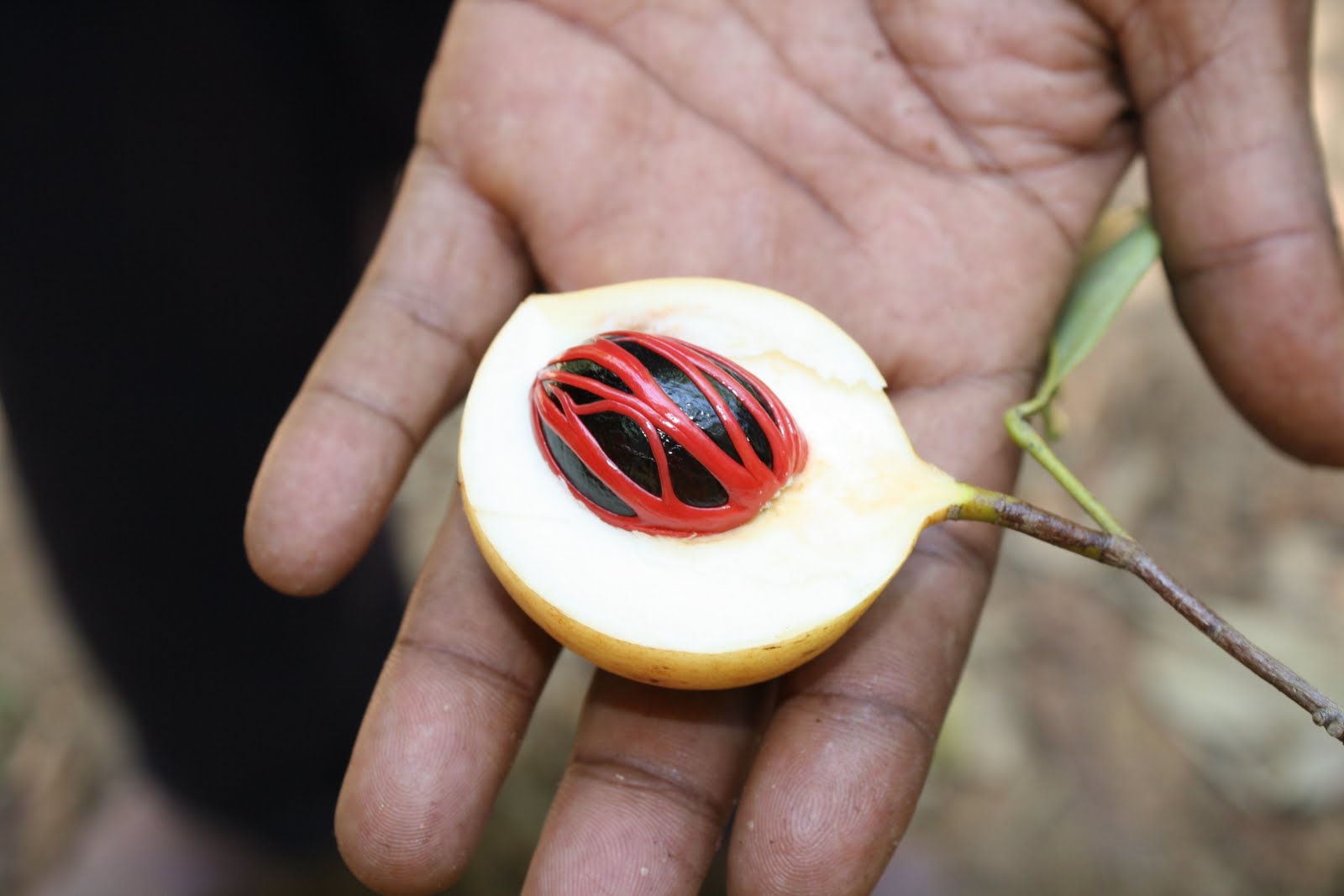
We hired a car and driver, along with Mr. Hussan, to take us to the northern part of Zanzibar where we toured a Spice Farm. We spent two hours walking among a very great assortment of spice and fruit trees. With us in a group was a couple from Germany and a man from Japan. Very interesting people. Zanzibar’s soil and climate make it an optimal place for growing a variety of spices that are commonly used in most of our kitchens. Tanzania exports spices in huge quantities. We enjoyed picking spice nuts off trees and smelling/eating them on the spot. After the walk-about, we enjoyed a lunch of rice and several of the spices that had been formed into sauces. Nothing else. Just rice and spices. The meal was enjoyable and very tasty.

Following the spice farm tour, we drove another hour to the northeast coast of Zanzibar. Matemwe is considered the best place to snorkel. So our guide rented a boat (an old, rickety dhow), a captain, a helper, and a snorkel guide. It was quite a sight as we ploughed through 30 minutes of a gorgeous deep blue Indian Ocean to find the coral reef that the guide had in mind for us to explore. We snorkelled along the edge of a coral reef that was teeming with sealife: needle fish, parrot fish, octopus, sea urchins, eels, and on and on and on.
When the sea became choppy, we thought it best to stop. But we thoroughly enjoyed our hour and a half in the water.

The white sand on the beach was remarkable.

It is surely the finest, whitest sand we’ve ever experienced. Just like powdered sugar or corn starch. Amazing! We know that we will be taking some of that sand back to Home Base with us in our clothes and shoes.

As the boat returned to shore, we had the first of two encounters with police during the afternoon’s trip. An aluminum boat approached us with two men in it. Of course we couldn’t understand the argument that took place but Mr. Hussan later told us that the men who approached were police who were checking to be sure that our boat had the correct permit to be able to snorkel out on the reef. However, they also were trying to be intimidating. According to Mr. Hussan, they didn’t identify themselves as police, they merely demanded to see the permit. Mr. Hussan argued with them and said that they should properly identify themselves before making demands.

The later confrontation was more energetic. As we returned to Stone Town from the beach, we passed through a police checkpoint. Mr. Hussan explained that our taxi needed a permit to take us to the beach. They had the permit, and had shown the police the permit on the way out to the beach. However, the police are not in charge of the permits. That is the responsibility of the Department of Tourism. The police can check licenses of both the tour guide and the driver, but often ask to see the license and then confiscate them until a ransom (for the license) is paid. Mr. Hussan and the driver claimed that they had forgotten their licenses and will show them at the police station in Stone Town within 24 hours. It is clear that police in Zanzibar are like those in many countries around the world! That reminds me that our taxi almost hit a goat that was crossing a country road. Mr. Hussan said that Zanzibar was just like the Philippines that we remember: if a driver hits a goat or any other animal, he has to stop and pay the owner for the animal. And, of course, the animal immediately becomes the very best example of its species in the entire world… and thus very, very expensive!

By the way, the highway we traveled on for much of the day is named the Bububu Highway. That’s because the highway parallels a major train track and in Zanzibar the sound of trains is “bububu” and not “choo-choo-choo!” Be that as it may, after a delightful journey into the countryside and an enjoyable snorkeling excursion, we returned to our hotel, and enjoyed a welcome shower and a walk to the Silk Route Restaurant where we enjoyed a dinner of prawns, dal, nan, and coconut and pineapple lassis. The young people next to us were students from Norway who were in Tanzania for a month on a study trip. At the end, they were required to write a 30 paper based on their experiences. While an employee from our hotel led us through winding, narrow alleys to the restaurant, we found our way back to the hotel on our own. We were proud of ourselves! Along the way, groups of men (don’t forget that this is an Islamic society) were gathered around several TVs to watch a football (soccer) game. At first, Kirk thought they might be watching the Super Bowl! In fact, no one in the entire country of Tanzania knows about America’s Super Bowl or cares. At one of the gatherings in a park near our hotel, a buffet was available to the thirty some men and boys who were gathered. Sorta like Buffalo Wild Wings places!

After a good night’s sleep, we slowly awoke this morning and eased into the day. Sunday is pretty much another day in Zanzibar, so stores were open and we did some shopping for grandchildren. After enjoying a Zanzibar prawn pizza for lunch,
we walked to the water front and watched several ferries being loaded. Not a machine in sight. 50-100 kilo bags of grain were all transferred from trucks to ships on the backs of not so young men. In incredibly sweltering hot sun and heat. To avoid the sun, we eventually found the shade of several palm trees, and there met a very gregarious couple from the Netherlands. Stories of their adventures entertained us until we needed to meet Mr. Hussan who guided us through the National Museum, took us to the airport, and sent us on our way back to Moshi after a fabulous weekend in Zanzibar.

We’ve showered, are enjoying our nightly allocation of M&M’s, and will soon be in bed… and then ready to go to work in the morning. The Super Bowl should be ending about the time we wake up on Monday. I’m hoping that the Packers win, but it’s not a big deal. After all, there are billions of people in Asia and Africa who don’t know that it’s going on!

Lala Salama… fo fo fo (“sleep well and don’t let the bed bugs or mosquitos bite!”)

Love you very much,
Babu and Mama Jean